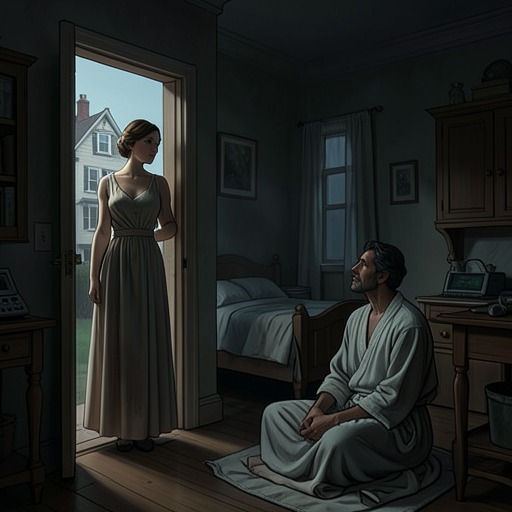
Alexander A. Gideon’s childhood
The Isolated Estate
[Alexander A. Gideon](entity:character-recall-character-alexander-a-gideon-ba99002324cd) grew up alone on the sprawling [Gudonski Estate](entity:location-recall-location-6c27c418726b), under the volatile authority of his father, [Vladimir Gudonski](entity:character-recall-character-d236731c2293). His mother’s early death and the estate’s dark rooms, overgrown gardens, and imposing rituals shaped a childhood in which solitude and watchfulness became habits.
His father encouraged him to master weapons and physical force, while the boy retreated into maps, machines, and private inventions. The estate became both a refuge for his imagination and the setting of the fear that formed him.
Alexander A. Gideon’s childhood and adolescence
Manfred’s Childhood Bond
[Manfred M. Zakheim](entity:character-recall-character-5396c13fafe1) became a trusted presence in [Alexander A. Gideon](entity:character-recall-character-alexander-a-gideon-ba99002324cd)’s childhood, offering companionship and practical care inside the intimidating household. The boy gave Manfred small gifts and affection, while Manfred learned how to temper his rages and keep him from feeling that kindness was a trick.
Their attachment survived Alexander’s years in the military and became a lifelong partnership. Its mixture of loyalty, service, and fear later makes it difficult for Manfred to refuse even Alexander’s most destructive demands.
When Alexander A. Gideon was a child
A Mother’s Death
Alexander’s mother died while he was still young, left alone during a gap between nurses while his father was away. The loss hardened the silence and abandonment already surrounding the boy, whose later memories repeatedly return to her photograph and the rooms she once occupied.
Decades afterward, he will find the remnants of her life in the estate and recover her sandals. Her absence gives his return to the house a force that is at once personal and painfully belated.
During Alexander A. Gideon’s childhood
The Monkey’s Death
Alexander’s rhesus monkey was his closest companion at the estate, where his father trained it to serve drinks like a human attendant. One day it bit Alexander, and Vladimir ordered the Armenian servant to shoot it.
Alexander buried the animal and made an epitaph for it. The episode became one of his earliest experiences of attachment ending in violence, and it foreshadows his later difficulty distinguishing care from control.
1959
The Young Officer
As a young officer, [Alexander A. Gideon](entity:character-recall-character-alexander-a-gideon-ba99002324cd) met Ilana Brandstetter while she served as a platoon clerk. She was drawn to his glacial composure and cutting authority, while he was inexperienced in intimacy and wary of emotional dependence.
Their attraction began as provocation and challenge: Ilana teased him about his inexperience, then took the initiative in kissing him. The charged balance between her pursuit and his guardedness became the pattern of their early relationship.
September 1959
A Marriage Begins
After a hesitant conversation about love, family, and Alexander’s plans to leave the army, Ilana Brandstetter agreed to marry him. The two married in September, and the union joined her hunger for emotional fusion to his need for control and distance.
Their private life was intense and inventive, but the same desires that bound them also fed jealousy and humiliation. The marriage began with a promise of closeness that neither knew how to sustain without turning it into a struggle.
Soon after the couple’s engagement
The Tsar’s Approval
Alexander brought Ilana to meet his formidable father, [Vladimir Gudonski](entity:character-recall-character-d236731c2293), at the family estate. Vladimir dominated the visit, showering attention on Ilana, demanding that she entertain him, and leaving his son almost no space to speak.
Ilana responded with amused compliance, while Alexander watched with jealousy and resentment. Vladimir’s theatrical welcome revealed how easily the family’s private loyalties could be rearranged by his will, and how readily Alexander’s authority collapsed before his father.
The first years of Alexander and Ilana’s marriage
The Unwanted Suitor
After the wedding, [Vladimir Gudonski](entity:character-recall-character-d236731c2293) asked Ilana to spend a night with him, promising that he would not touch her and presenting the request as a romantic escape. When she refused, he insulted her and accused her of trapping his son.
Alexander did not protect her decisively from his father’s appetite for domination. The incident deepened the marriage’s entanglement with jealousy, fantasy, and humiliation, while leaving open the question of whether Vladimir had already become a figure in their erotic imagination.
1960
Boaz Is Born
Ilana chose to have a child, and [Boaz Brandstetter](entity:character-recall-character-boaz-brandstetter-b9b4e9662363) was born while [Alexander A. Gideon](entity:character-recall-character-alexander-a-gideon-ba99002324cd) resisted the prospect of fatherhood. Vladimir arranged for an Italian firm to provide a certificate naming a mountain in the Himalayas after the infant, a grand gesture that could not resolve the family’s underlying uncertainty.
Alexander nevertheless formed a serious bond with the boy. Boaz grew up watching his parents’ volatile intimacy and learning to read their silences, while the question of his biological paternity remained unresolved in law and in the family.
Boaz’s early childhood
The Household’s Private War
Alexander and Ilana’s marriage increasingly turned intimacy into a game of jealousy, confession, and punishment. Ilana’s affairs and the couple’s fantasies of sexual competition became part of a relationship that was at once passionate and destructive.
Boaz witnessed the damage from the margins. The adults’ private war made the home unstable, and his childhood affection for both parents became bound up with fear that he was responsible for their suffering.
During the later years of the marriage
Ilana’s Suicide Attempts
As the marriage deteriorated, Ilana made repeated suicide attempts, using tablets and gas. Alexander’s responses mixed fury, sexual aggression, and attempts to wrest confessions from her, deepening the cycle of harm rather than ending it.
Boaz sometimes tried to intervene, once throwing a small cactus at Alexander to make him stop hitting his mother. The child’s intervention exposed the family’s violence and foreshadowed the anger and physical force that would later mark his own adolescence.
Two months before the 1968 divorce
Boaz’s Kidney Crisis
Boaz was hospitalized at Shaarei Zedek with a kidney infection that developed complications. Without Ilana’s knowledge, Alexander asked the doctor whether an adult could donate a kidney to the child and offered to give one of his own.
He insisted that neither Ilana nor Boaz should ever learn of the offer. The secret became evidence that his distance concealed a capacity for sacrifice, even as he continued to behave as though tenderness were a weakness.
1968
The Divorce Battle
The marriage ended in vicious court proceedings after Ilana admitted adultery. The [Rabbinical Court](entity:organization-recall-organization-rabbinical-court-5d463a3f46d2) ruled that she forfeited her marriage settlement and maintenance, while the [Jerusalem District Court](entity:organization-recall-organization-jerusalem-distri-173c87ca379b) recorded an inconclusive blood test and the parties’ refusal to undergo tissue testing.
Ilana opposed testing because she feared that proving Alexander’s paternity would give him grounds to take Boaz from her. Alexander also declined testing and insisted he was not the father. The decree ended with both sides declaring that they had no further claims against each other, leaving the boy’s identity and custody unresolved.
After the 1968 divorce
Ilana and Boaz Leave Home
Alexander forced Ilana and Boaz out of his home and cut them from his life. With no money or other place to go, Ilana took the boy to stay with her sister at [Kibbutz Beit Avraham](entity:organization-recall-organization-kibbutz-beit-avr-0108f3e698e1).
Ilana later returned to [Jerusalem](entity:location-recall-location-jerusalem-8e4409a0f555) and found work in a bookshop, while Boaz remained at the kibbutz for years. She visited every few weeks, but the separation from his mother and the abrupt loss of Alexander’s household became the foundation of Boaz’s growing alienation.
After Vladimir’s decline and before the present correspondence
A Secret Inheritance Preserved
[Vladimir Gudonski](entity:character-recall-character-d236731c2293) withdrew from public life and began scattering his wealth among religious and political causes. [Manfred M. Zakheim](entity:character-recall-character-5396c13fafe1) worked to preserve the estate for Alexander, navigating legal battles as Vladimir dismissed him, rehired him, and attempted to disperse the property.
Vladimir was eventually committed to a sanatorium on [Mount Carmel](entity:location-recall-location-9a802fa5c028) and later signed a will in favor of his son. The fortune Zakheim saved would become the instrument through which Alexander tried to repair old injuries—and the means by which he could exert power over the people he had lost.
About a year after the divorce
Michel Enters Ilana’s Life
Ilana met [Michel-Henri Sommo](entity:character-recall-character-86516fa3d8f5) at the [Jerusalem](entity:location-recall-location-jerusalem-8e4409a0f555) bookshop where she worked. He was a poor, shy French teacher and former laborer who waited for her after closing, took her to inexpensive outings, and slowly told her about his life and convictions.
Ilana liked his modesty and patience. After months of courtship, she took the initiative in their physical relationship, and Michel, overwhelmed, asked her to marry him.
1970
Ilana Marries Michel
Ilana married [Michel-Henri Sommo](entity:character-recall-character-86516fa3d8f5) and later gave birth to their daughter, [Madeleine Yifat](entity:character-recall-character-9dad3ce5d7c0). Michel’s gentleness, daily attentions, and devotion offered Ilana a domestic life unlike the violent intensity she had known with Alexander.
Boaz rejected the marriage and called his mother a whore, refusing to visit her in [Jerusalem](entity:location-recall-location-jerusalem-8e4409a0f555). The new household could not erase his sense of abandonment, and he remained estranged from both Ilana and Michel.
When Boaz was thirteen and a half
Michel Welcomes the Boy
One winter night Boaz arrived at Ilana’s flat demanding a transfer to agricultural school and threatening to live on the streets. Michel refused to be intimidated, told him to calm down and start again, and insisted on basic respect before discussing his request.
Boaz turned to leave, but Ilana stood between him and the door. Though he insulted Michel and revealed his contempt for the marriage, he also noticed that [Madeleine Yifat](entity:character-recall-character-9dad3ce5d7c0) was pretty, a brief tenderness amid his anger.
Early 1974
The Agricultural School
With help from Michel’s family, Boaz entered [Telamim Agricultural High School](entity:organization-recall-organization-telamim-agricult-a302eca7435f). Ilana and Michel agreed not to visit him, honoring his demand for distance while paying the fees and hoping the school would give him a way forward.
Instead, reports accumulated of fights, disappearances, police trouble, and probation. The quiet child Alexander remembered had become a tall, angry adolescent whom school officials increasingly regarded as a threat.
Early 1976
Boaz’s Expulsion Crisis
After Boaz struck a woman teacher who had slapped him, the school decided to expel him. Ilana went to plead for more time, but Boaz refused to see her and repeated the insult he had used against her since her remarriage.
With no realistic alternative school and no money for treatment, Ilana wrote to Alexander after seven years of silence. Her appeal mixed urgent concern for Boaz with a willingness to humiliate herself if that would persuade his father to help.
5 February 1976
Ilana’s Desperate Appeal
Ilana’s letter described Boaz’s worsening condition and asked Alexander to use his money and influence to prevent the boy from being discarded. She recalled their financial desperation, Boaz’s bitterness, and the kidney donation Alexander had once planned in secret.
She offered to sign away any claim about paternity and even proposed sleeping with him if that would rescue Boaz. The letter was both a plea for practical intervention and an attempt to reopen the emotional bond that neither former spouse had escaped.
18 February 1976
Alexander Reverses the Expulsion
Alexander replied from [London](entity:location-recall-location-1bfd335cdd1b) that he had contacted an acquaintance in [Israel](entity:location-recall-location-e1a1566e26c9) and arranged for the school to cancel Boaz’s expulsion, replacing it with a warning. He also sent two thousand dollars through [Manfred M. Zakheim](entity:character-recall-character-5396c13fafe1), carefully labeling the payment a hardship gift rather than an admission of obligation.
His formal, contemptuous reply refused Ilana’s emotional terms while acting on her practical request. The money and intervention brought the former spouses back into contact without settling what either of them wanted from the other.
19–22 February 1976
Boaz Leaves School
When told that he would not be expelled, Boaz left [Telamim Agricultural High School](entity:organization-recall-organization-telamim-agricult-a302eca7435f) anyway. He was arrested in [Tel Aviv](entity:location-recall-location-12ac8c86a4b9) on suspicion of possessing stolen goods and initially refused to be released, insisting that he wanted to be left alone.
Michel went to Abu Kabir, spoke to him without Ilana, and offered neither sentimental pleading nor a promise to control him. Boaz finally agreed to leave on bail, and Michel arranged work with a wholesale greengrocer connected to his family.
Late February 1976
Michel’s Bargain with Boaz
At the police station, Michel told Boaz that he was neither his father nor his mother and would not pretend otherwise. He gave the boy a choice: leave on bail and make a practical plan, or stay in custody and accept the consequences.
Boaz challenged Michel by asking why he had come if he did not care. Michel answered with humor rather than a declaration of love, then took him to a restaurant and a film. Their wary exchange created the first real opening between them.
Late February 1976
Boaz Takes the Telescope Job
Boaz chose to work rather than depend on anyone, and Michel arranged a job at the market and a place to stay at [Ramat Aviv Planetarium](entity:location-recall-location-061105af9fb3). Boaz was drawn not to astronomy in the abstract but to telescopes and optical equipment.
Ilana and Michel decided that Alexander’s money would be kept for Boaz’s future rather than used for themselves. The arrangement let the boy build a measure of independence while Michel quietly became a person he could approach without surrendering his pride.
7 March 1976
A Second Payment
Alexander sent Michel another five thousand dollars, accusing him of manipulating Ilana into asking for money. He invited Michel to state the final sum required to solve the family’s financial problems, but demanded that no one question his motives or thank him effusively.
Michel and Ilana later asked [Manfred M. Zakheim](entity:character-recall-character-5396c13fafe1) for much more: funds for their mortgage, their children’s future, and the purchase of [Alkalai House](entity:location-recall-location-8554ed341d55) in [Hebron](entity:location-recall-location-f4e5c0baf798). Their appeal entangled Alexander’s private reparations with Michel’s religious and political mission.
March 1976
Zakheim Investigates the Sommos
At Alexander’s request, [Manfred M. Zakheim](entity:character-recall-character-5396c13fafe1) hired investigators to examine Michel’s finances, politics, family, and connections. Their report described a modest income, strong religious and nationalist commitments, and links to the [Jewish Fellowship Movement](entity:organization-recall-organization-jewish-fellowshi-7c3a8d9266d8), along with Michel’s recent restoration of French citizenship.
A second report traced Boaz’s school departure, arrest, probation, and stay at the Planetarium. Zakheim also sent copies of the old court decisions, emphasizing Ilana’s adultery and the refusal of both former spouses to undergo tissue testing.
Late March 1976
Zakheim Confronts Michel
Zakheim suspected that Michel was using guilt or blackmail to draw money from Alexander. Michel answered that Alexander’s shame, not pressure from him, was driving the payments, and presented his role as one of repentance and religious symbolism.
Their meeting revealed that Michel was more politically calculating than Zakheim had expected, but also genuinely committed to his beliefs. Zakheim warned Alexander that he might be financing a zealot; Alexander ordered him to pay the requested money anyway.
April 1976
The Boaz Loan
Boaz wrote Michel asking for a loan to buy materials for a do-it-yourself telescope. He described his work and his accommodation at the Planetarium, and asked that Ilana not be involved to avoid complications.
Michel sent the requested money but refused secrecy, explaining that he and Ilana kept no hidden arrangements from each other. Boaz accepted the terms and began repaying the loan, a small but meaningful step toward trust between the boy and his stepfather.
23 April 1976
Michel’s Lesson in Pride
Boaz asked how Michel had managed to buy the Larousse dictionary his uncle refused to lend him money for. Michel explained that he had left the job in wounded pride and worked cleaning stairs until he could afford it.
He invited Boaz to come home for a [Sabbath](entity:time-recall-time-sabbath-273d41747ebe) and offered him a room in the planned extension. His account of his own stubbornness was a gentle attempt to help Boaz distinguish self-respect from the pride that kept him isolated.
20 March 1976 and the following visit
Rahel Warns Ilana
During a visit to [Jerusalem](entity:location-recall-location-jerusalem-8e4409a0f555), [Rahel](entity:character-recall-character-fc798769ead5) listened as Ilana described the letters, payments, and renewed contact with Alexander. She saw Ilana’s fascination with the old marriage as dangerous and urged her to leave Boaz to Michel’s care, protect her new family, and refuse further money.
Ilana heard the advice as another attempt to manage her life. Rahel’s warning nevertheless identified the danger at the center of the renewed correspondence: each payment was becoming a new way for Alexander and Ilana to revive their old contest.
19 April 1976
Ilana Reveals Her Ruse
In a secret letter to Alexander, Ilana admitted that she had expected Michel to rescue Boaz and had never believed Alexander would know how to care for the boy. She had written because she wanted Alexander to send her the bill, to place herself again in his power, and to provoke the man whose silence had haunted her.
She described her attraction as a bond of hatred and longing rather than a wish for ordinary reconciliation. Her confession made clear that the plea about Boaz had also been a trap aimed at the former husband she still called her master.
Spring 1976
Michel and Boaz Grow Close
Michel persuaded Boaz to visit [Jerusalem](entity:location-recall-location-jerusalem-8e4409a0f555), where the boy and [Madeleine Yifat](entity:character-recall-character-9dad3ce5d7c0) competed playfully for attention. The family shared a meal and went to the cinema, while Michel’s practical kindness began to win Boaz’s regard.
Ilana watched the two become almost friends and recognized that Alexander’s money had not created the bond. Michel’s care had done that. The rapprochement unsettled the emotional strategy of her correspondence with Alexander, because the boy was finding a place without his biological father’s return.
Early May 1976
Boaz Attacks His Employer
After Abraham Abudarham kicked him for insolence, Boaz struck the older man with a vegetable crate. Michel condemned the violence but wrote Boaz an angry, lengthy letter insisting that strength meant self-restraint rather than the ability to hurt someone.
Michel offered practical choices: apologize, stay with friends, study optics or a trade, or return to [Jerusalem](entity:location-recall-location-jerusalem-8e4409a0f555), but continue receiving support only if he stopped committing violence. His fierce sermon expressed both affection and a need to shape Boaz according to his own moral and religious order.
Early May 1976
Boaz Runs Away to Sea
Boaz apologized to Abraham and the Fuchs family, then left a note saying he was going to sea. He told Ilana that he was sorry she had ever had him, a bleak mixture of affection and self-erasure.
[Rahel](entity:character-recall-character-fc798769ead5) reassured the Sommos that Boaz’s need to disappear did not mean he was incapable of decency, but urged them to keep searching. Michel asked Alexander to use his influence to locate the boy, finally seeking help without asking for another payment.
9–15 May 1976
Alexander Offers a Paternity Test
Michel wrote Alexander that Boaz had disappeared and asked for help finding him, while demanding an apology to Ilana and urging a donation to the redemption of land. Alexander agreed to search and offered another fifty thousand dollars if Ilana would consent to tissue testing for paternity.
Ilana withdrew her earlier objection but told Zakheim that the decision was unrelated to the money. Alexander’s private letter demanded an explanation for the 1968 refusal and offered to name Boaz his heir if she answered honestly instead of taking the test.
24 May 1976
Ilana Explains the Test Refusal
Ilana told Alexander that she had opposed the tissue test because she feared that proof of his paternity would enable the court to give him custody of Boaz. She had hoped to obtain financial support without losing the eight-year-old child to a father she believed hated them.
Alexander answered that he had refused the test because he did not want the court to attach Boaz to him when he did not know how to raise him. Each had mistaken the other’s refusal for rejection, and their shared fear had helped produce the boy’s long separation from both parents.
Late May 1976
Boaz Found at Sharm
Alexander learned that Boaz was working on a glass-bottomed tourist boat at [Sharm el-Sheikh](entity:location-recall-location-c273333c8b51) and instructed Zakheim’s investigators to leave him alone. Boaz then asked for money to buy a boat, start a business, and build a telescope for tourists.
Alexander initially refused, but Boaz’s requests and Michel’s insistence on keeping the boy under supervision made money the continuing language of their relationship. Alexander ultimately authorized a loan against property and told Zakheim to give Boaz what he asked for, calling it the last time.
10–12 June 1976
Boaz’s Fight in Ophira
A tour boat associated with Boaz was stolen and used by smugglers. When police arrested his Bedouin friend, Boaz intervened and fought the officers with a tire on a rope, injuring several police and soldiers before being overpowered.
He was arrested, then broke through a wall at the Ophira station and escaped. Investigators eventually located him at [Kiryat Arba](entity:location-recall-location-d5ce505080a0), where he had taken refuge among young members of the [Jewish Fellowship Movement](entity:organization-recall-organization-jewish-fellowshi-7c3a8d9266d8), but he disappeared again before the police could find him.
June–July 1976
Michel’s Political Ascent
Michel moved from teaching French toward land development and political organizing, using his family connections and the money from Alexander to pursue religious-nationalist projects. He pressed Zakheim to support the [Jewish Fellowship Movement](entity:organization-recall-organization-jewish-fellowshi-7c3a8d9266d8) and to help secure property in the territories.
Zakheim saw opportunity in Michel’s energy and connected him with [Zohar Etgar](entity:character-recall-character-zohar-etgar-8a119904ecfc), whose commercial ambitions could channel Michel’s activism into real estate. Michel’s new public life began changing the modest household that Ilana had built with him.
July 1976
Boaz Settles at Kiryat Arba
Michel placed Boaz in [Kiryat Arba](entity:location-recall-location-d5ce505080a0), where he could work in an optics shop and live among religious young men. Boaz valued the workshop but rejected the religious instruction and the group’s hostility toward Arabs.
Michel treated the placement as a chance to discipline and guide the boy, while Boaz saw it as another attempt to make him conform. Their conflict sharpened when Boaz asked for access to his share of Alexander’s money and permission to leave.
July 1976
Boaz Rejects Michel’s Authority
Boaz wrote Michel that he had never struck anyone unless he believed he was entirely right, and that Michel’s repeated favors felt like a means of controlling him. He rejected the religious community and asked to leave, while arguing that the money Alexander had sent partly belonged to him.
Michel replied that the funds were held for the children and would not be handed to Boaz before he came of age. He sent a small amount anyway and urged Boaz to return to [Jerusalem](entity:location-recall-location-jerusalem-8e4409a0f555), leaving the young man caught between dependence and resistance.
23 July 1976
Alexander Offers Boaz a Choice
Boaz wrote Alexander directly, asking whether the money had been intended for him and why Michel controlled it. Alexander answered without a lecture, accepting Boaz’s wish to be independent and offering him a choice between a ticket and a job in the [United States](entity:location-recall-location-5d55e9152db1) or paid work restoring the abandoned house near [Zikhron Ya'aqov](entity:location-recall-location-3b79f3a76177).
He told Boaz to contact [Roberto di Modena](entity:character-recall-character-roberto-di-modena-55a02fbb6bf0) rather than Zakheim and promised freedom to do only the work he chose. Boaz selected the house, an offer that brought him into his grandfather’s neglected estate and into Alexander’s life by a new route.
Late July 1976
Boaz Moves to the Estate
[Roberto di Modena](entity:character-recall-character-roberto-di-modena-55a02fbb6bf0) arranged Boaz’s move to the old family property, despite formal difficulties and [Manfred M. Zakheim](entity:character-recall-character-5396c13fafe1)’s objections. Alexander instructed him to pay Boaz a preliminary sum and a monthly wage for restoring the house.
Zakheim warned that a buyer was offering a large price and could employ Boaz, but Alexander refused to sell the [Zikhron](entity:location-recall-location-afe4f72c8c96) property and put Roberto in charge. His decision established the ruined estate as the stage for the family’s next confrontation.
Summer 1976
The Estate Becomes a Commune
Boaz gathered young drifters at the estate and began repairing the house, cultivating a garden, caring for animals, and building practical equipment. He made a telescope and a slide for [Madeleine Yifat](entity:character-recall-character-9dad3ce5d7c0), while insisting that residents should work, live freely, and refrain from preaching or controlling one another.
His loose commune contrasted with both Michel’s religious community and Alexander’s military order. Boaz’s work gave the neglected property a new purpose and revealed a moral code centered on nonviolence, usefulness, and personal freedom.
Early August 1976
Ilana Visits the Ruins
Ilana went to the estate, expecting rejection, and found Boaz living among young women and the beginnings of his settlement. He welcomed her without ceremony, gave her water and food, asked after [Madeleine Yifat](entity:character-recall-character-9dad3ce5d7c0), and invited her to stay and work.
Boaz told her that he did not hate Alexander or Michel, and that he had loved both parents even when their fighting made him feel responsible. He urged Ilana to stop treating herself as useless and to do something with her life, offering her work and a place in the house.
During Ilana’s visit to the estate
Boaz Names His Rules
Boaz explained his opposition to hatred, mockery, and violence, and his conviction that people should spend some part of each day doing useful work. He described himself as a Zionist who wanted people to live rather than kill one another over politics or religion.
His principles—later recorded by Ilana as his ten commandments—directly contradicted the ideological certainty of both Alexander and Michel. They also offered a fragile alternative to the family’s inherited habits of domination and revenge.
Summer 1976
Zakheim’s Land Deal
Zakheim developed a scheme to connect Michel’s land-redemption ambitions with [Zohar Etgar](entity:character-recall-character-zohar-etgar-8a119904ecfc)’s business interests and a Parisian financier. Michel’s [Jewish Fellowship Movement](entity:organization-recall-organization-jewish-fellowshi-7c3a8d9266d8) became a security and reconnaissance operation for the investment company [Tentpeg](entity:organization-recall-organization-tentpeg-1f30887edf73), while the group pursued property exchanges involving [Bethlehem](entity:location-recall-location-962e0c387ef4) and French religious institutions.
Zakheim hoped to turn Michel’s zeal into a profitable enterprise and draw Alexander’s money into it. He also tried to manage the personal relationships around the deal, warning Michel that Ilana’s renewed correspondence with Alexander could upset their plans.
Summer 1976
The Money Changes Michel
As money and political opportunities entered the Sommo home, Michel resigned from teaching, bought new clothes, sought a car, and began moving among officials and investors. He planned to sell the family flat and acquire a home in the [Jewish Quarter of the Old City](entity:location-recall-location-2add31a047bc).
Ilana watched their small rituals of domestic happiness give way to business meetings, religious guests, and Michel’s certainty that Alexander’s fortune would finance his mission. She feared that the man who had once made her life gentle was becoming a smaller, more complacent version of Alexander.
4 August 1976
Ilana Tries to Retreat
After [Rahel](entity:character-recall-character-fc798769ead5) urged her to protect her marriage and daughter, Ilana wrote that she would become a dutiful wife, support Michel’s ambitions, and stop chasing Alexander. Her vision of domestic respectability gradually turned into a bleak picture of a woman waiting alone for her husband to return.
The letter showed that Ilana could imagine obedience but could not believe it would restore intimacy. Her promised retreat was less a decision than another performance of self-erasure, and the old correspondence continued to pull her toward Alexander.
August 1976
Ilana Revisits Her Childhood
In a long letter to Alexander, Ilana revisited her childhood as the daughter of immigrants, her parents’ deaths, and her early years in [Israel](entity:location-recall-location-e1a1566e26c9). She set her own history of loss beside Alexander’s childhood loneliness and tried to understand why his cruelty had attracted her.
She recounted how she first provoked him as a young officer, kissed him during a stormy drive, and gradually drew him into an intense relationship. Her memories exposed how their marriage began with mutual vulnerability before being consumed by jealousy, affairs, and violence.
August 1976
Alexander Returns to His Estate
Alexander returned to [Israel](entity:location-recall-location-e1a1566e26c9) while seriously ill and went to the abandoned estate where he had grown up. There he found Ilana, who had come to see Boaz, and chose to remain rather than return to the hospital or a hotel.
The ruined house, his mother’s old rooms, and the sounds of Boaz’s growing commune brought Alexander face to face with the childhood he had tried to leave behind. His presence transformed the estate from Boaz’s project into a shared, uneasy shelter for the three generations.
August 1976
Ilana Visits Vladimir
Before reaching the estate, Ilana visited [Vladimir Gudonski](entity:character-recall-character-d236731c2293) at his sanatorium on [Mount Carmel](entity:location-recall-location-9a802fa5c028). His mind wandered through memories of Russia, war, women, religion, and the making of [Palestine](entity:location-recall-location-cdbda353b3fa), moving unpredictably between lucidity and confusion.
Vladimir briefly recognized Ilana as his son’s widow and urged her to live and hope. His broken recollections exposed the mixture of cruelty, longing, and regret behind the family’s inheritance, while his impending death echoed Alexander’s own illness.
During Ilana’s visit to Vladimir
The Sick Child at Home
While Ilana was away, [Madeleine Yifat](entity:character-recall-character-9dad3ce5d7c0) developed an ear infection. Michel canceled an important meeting, took her to the doctor, prepared food and medicine, and stayed beside her through the day and night.
When Ilana returned, she responded to his care with anger and accusations, then broke down in tears. The episode showed how her guilt and fear could distort even the gentleness she trusted most, and how Michel’s devotion to their daughter remained real despite the changes in his ambitions.
Early September 1976
Alexander Explains the Divorce
Alexander told Michel that he had divorced Ilana because their life together had become painful and he had acted from hatred and vindictiveness. He admitted that he had never known how to raise Boaz and had refused the paternity test partly because he feared a court would make him responsible for a child he could not care for.
He also disclosed that his kidney cancer had spread and that further surgery was not possible. The confession replaced some of Michel’s suspicions with facts, though it could not undo the years of harm or settle the question of how the two men might live alongside one another.
3 September 1976
Michel Demands Yifat’s Return
Believing that Ilana had resumed a relationship with Alexander, Michel sent a warning to the estate demanding that [Madeleine Yifat](entity:character-recall-character-9dad3ce5d7c0) be returned to him. He threatened to have friends collect her and invoked religious law to describe Ilana as potentially forbidden to both husband and former husband.
His letter mixed genuine anguish with accusation and the language of possession. It brought the quiet arrangement at the estate close to a family crisis, with the child’s custody and Ilana’s marriage suddenly at stake.
4 September 1976
Alexander Appeals to Michel
Alexander answered Michel’s accusations by explaining that Ilana had chosen to stay and that their relationship was no longer conventionally marital. He acknowledged Michel’s goodness, apologized for the trouble his existence caused, and asked that Ilana and [Madeleine Yifat](entity:character-recall-character-9dad3ce5d7c0) be allowed to remain at the estate while he received treatment.
He offered Michel half his inheritance if he would leave them there. The appeal was not only a bargain but a confession of dependence: Alexander, who had relied on money and power, was asking the man he had resented to show mercy.
Conclusion of the Sabbath on 4 September 1976
Michel Forgives Alexander
Michel apologized for his harsh letter and invited Alexander to come to [Jerusalem](entity:location-recall-location-jerusalem-8e4409a0f555) for treatment, offering him a place in the Sommo home. He said Boaz should stay close to his father and expressed faith that remorse, suffering, and divine mercy might bring recovery.
The invitation broke through the men’s mutual suspicion. Michel’s response turned a proposed financial exchange into an act of hospitality and forgiveness, even as Alexander’s illness made the time for reconciliation painfully short.
After the early September reconciliation
Michel Takes Yifat Home
Michel took [Madeleine Yifat](entity:character-recall-character-9dad3ce5d7c0) back to [Jerusalem](entity:location-recall-location-jerusalem-8e4409a0f555) and began divorce proceedings against Ilana, treating her departure as a breach of their marriage. He stopped communicating with her directly and used religious authorities to describe her as a rebellious wife.
Ilana remained at the estate, torn between caring for Alexander and longing for Michel and her daughter. Her letters reveal that the separation was not a clean break but another punishment enacted through silence, distance, and control.
September 1976
Ilana Becomes Alexander’s Caregiver
As Alexander’s illness worsened, Ilana moved into his room and cared for him through pain, confusion, and growing physical dependence. She shaved and dressed him, fed him, helped him to the toilet, changed his bedding, and stayed beside him through frightened nights.
Alexander alternated between helplessness and flashes of his old strategic intelligence. Their roles reversed without dissolving their old erotic and emotional bond; Ilana’s care became both an act of mercy and a continuation of the attachment she could not escape.
September 1976
Alexander Begins Chemotherapy
Alexander traveled regularly to [Hadassah Hospital](entity:location-recall-location-hadassah-hospital-1662651c1444) for chemotherapy after radiotherapy was stopped. The treatment brought some improvement in pain, but his strength remained limited and his mind was often clouded by medication.
Boaz adapted the house to his father’s needs, making sandals, furniture, shutters, and a bell system, while keeping conversation to the bare minimum. Their practical care formed a quiet bond that Alexander had once believed impossible to build.
September 1976
Alexander Transfers the Estate
Alexander instructed [Manfred M. Zakheim](entity:character-recall-character-5396c13fafe1) to transfer the estate and land to Boaz and to continue paying for the boy’s work. He also directed that money be sent to Michel, despite the men’s continuing conflict, and made gifts to Zakheim and his family.
His decisions attempted to redirect the inheritance from private power toward the young people rebuilding the estate. The property that had once embodied Vladimir’s dominance and Alexander’s isolation was becoming Boaz’s home and a working communal settlement.
Autumn 1976
Boaz’s Commune Restores the House
Boaz and the residents cleared the overgrown grounds, repaired rooms and utilities, planted vegetables and fruit trees, and built animal shelters and workspaces. They replaced the ornamental garden with productive land and restored the water hole and pool.
The estate’s transformation made the communal life more than an escape from conventional family structures. Boaz’s group created a place sustained by shared labor, while Alexander watched from his sickroom and recognized the value of what his son was building.
Autumn 1976
The Mother’s Sandals
While settling into his childhood room, Alexander found the remains of his mother’s sandals beneath a loose floorboard and hung them on a rusty nail. He also recovered her stained photograph and placed it on his table.
These objects brought the past into his daily care and made the old house a place where the dead and living seemed to coexist. Ilana’s presence beside him acquired a tenderness that neither of them could express without returning to the wounds of their marriage.
Autumn 1976
Boaz Teaches His Father to Live
Alexander asked Boaz whether he could contribute to the commune, but Boaz replied that no one there told anyone else what to do. He nonetheless made furniture for his father, arranged practical comforts, and eventually began teaching him grammar and spelling.
Their exchanges were brief and awkward, yet meaningful. Alexander learned that care could take the form of quiet labor rather than authority, while Boaz offered the father who had abandoned him a place in the house without pretending the past had vanished.
21 October 1976
Ilana’s Letter to Michel
From the estate, Ilana wrote to Michel about the rain, the commune, and Alexander’s worsening dependence. She imagined Michel at home with [Madeleine Yifat](entity:character-recall-character-9dad3ce5d7c0) and remembered their ordinary domestic rituals, while admitting that she still longed for his body and his kindness.
She asked whether he would bring their daughter and return to the life they had built. Her letter held no practical solution, only the recognition that the family had been divided by pride, punishment, and a longing that remained stronger than any clear decision.
Autumn 1976
The House Becomes a Sickroom
Alexander’s health declined, and Ilana cared for him through confused nights and days of near silence. She played cards with him, managed his medicines, and described their relation as that of two children who had lost the ability to speak.
Boaz carried his father upstairs each night and made the house workable around him. The estate became a sickroom, a family refuge, and a communal home at once, bringing people together without resolving the conflicts that had separated them.
Late October 1976
The Family’s Unfinished Future
Ilana’s final letter imagined a future in which Michel might return, [Madeleine Yifat](entity:character-recall-character-9dad3ce5d7c0) could rejoin Boaz, and Alexander might be warmed between the two adults who had once loved and injured one another. She also recognized that the estate’s settlement might eventually disperse, leaving her alone with the dying man.
She asked where the promised land could be found, then withdrew the request for prayer and instead urged Michel to care for their daughter in ordinary, loving ways. The novel ends not with reconciliation secured but with a fragile appeal to keep living and caring for one another.
28 October 1976
Michel’s Psalm
Michel sent a short reply addressed to Alexander, Ilana, and Boaz, quoting a psalm about mercy, patience, and the frailty of human life. He offered no explanation of the family’s future and did not answer Ilana’s plea point by point.
The closing words place the story’s unresolved relationships beneath an appeal to compassion. After a novel filled with demands for justice, repentance, and control, the final gesture is a prayer that mercy might exceed what any of them has earned.